

A low shelf price can hide a small pack, while a bulk bargain can become expensive when part of it goes unused. Yoghurt price per litre gives Kenyan shoppers a clearer starting point for comparing pack value. It works best alongside product type, storage, delivery and the quantity you can actually use.
This guide uses verified Sajayis catalogue prices to show the arithmetic. It also explains serving-cost examples and common comparison mistakes. The calculations describe the listed products and quantities; they do not establish wholesale terms, nutritional equivalence or a guaranteed resale margin for another business.
Yoghurt price per litre: use the same unit
Convert the pack volume to litres, then divide the price by that volume. A 500 ml pack contains 0.5 litre. Therefore, a pack priced at KSh 180 has an equivalent price of KSh 360 per litre. A one-litre pack priced at KSh 350 is KSh 350 per litre.
For a 5-litre pack priced at KSh 1,200, the calculation is 1,200 divided by five, giving KSh 240 per litre. The arithmetic makes pack sizes comparable without suggesting that different product formulations are identical.
Keep weight and volume distinct. A pack labelled in grams should not automatically be treated as the same number of millilitres. Use the declared quantity and relevant product information. An unsupported conversion can make both price and nutrition comparisons misleading.
The FAO food labelling discussion explains how labels communicate product information. For a price comparison, read the actual quantity and product identity rather than assuming that similar-looking containers hold the same amount.
Compare the verified Sajayis pack prices
The following catalogue prices were checked on 12 November 2026. Confirm the selected variation and current price at ordering, since availability and offers can change. Each row describes a specific listing rather than a universal Kenyan market price.
| Product and pack | Listed price | Equivalent per litre |
|---|---|---|
| Fermented Yoghurt, 500 ml | KSh 130 | KSh 260 |
| Fermented Yoghurt, 1 litre | KSh 250 | KSh 250 |
| Probiotic Yoghurt, 500 ml | KSh 180 | KSh 360 |
| Probiotic Yoghurt, 1 litre | KSh 350 | KSh 350 |
| Greek Yoghurt, 500 ml | KSh 230 | KSh 460 |
| Greek Yoghurt, 1 litre | KSh 450 | KSh 450 |
| Natural Yoghurt, 1 litre | KSh 250 | KSh 250 |
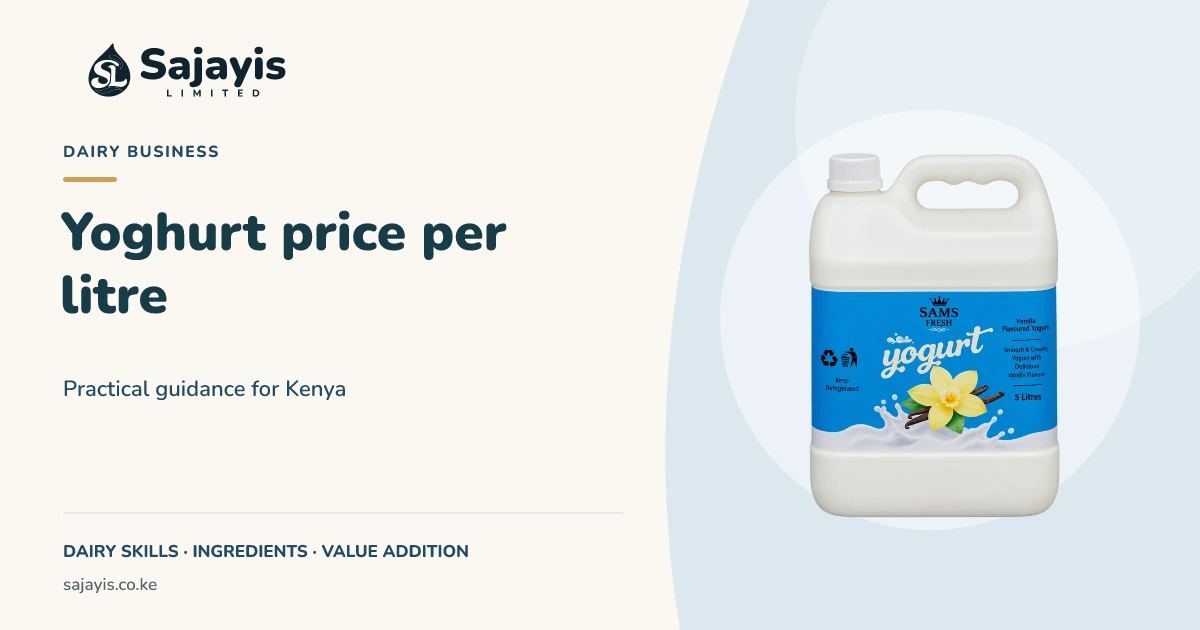
| 5 Litre Yoghurt | KSh 1,200 | KSh 240 |
Check the available yoghurt packs for the actual product you want. Ask about ingredients, flavour and handling where the short listing does not provide enough detail. A lower equivalent price does not prove that a product meets your dietary or serving requirement.
Yoghurt price per litre: compare like products first
Start with different pack sizes of the same product where possible. That makes the price difference easier to interpret. For the listed Probiotic Yoghurt, two 500 ml packs total KSh 360, compared with KSh 350 for the one-litre option.
The KSh 10 difference is clear, but convenience may still matter. Separate packs may suit different collection times or users. Conversely, a household that will use the full litre appropriately may prefer the lower equivalent price and fewer individual packs.
When comparing different products, add the relevant product information. Greek, natural and probiotic descriptions concern different product offers. Do not rank them for protein, sugar or health outcomes using price alone. Ask for verified nutrition information if that is central to your decision.
Likewise, a bulk pack may differ in flavour or presentation from a smaller listing. Confirm what is supplied before applying its price to an event plan. The cheapest equivalent litre is useful only when the actual food and pack fit the intended use.
Calculate the cost of the quantity you will serve
Choose a planning quantity that fits your meal or event, then calculate its cost. For example, dividing the listed KSh 250 one-litre Natural Yoghurt pack into five equal 200 ml quantities gives KSh 50 each before additions or losses.
For the 5-litre yoghurt pack, a 150 ml planning quantity costs KSh 36 at KSh 240 per litre. Cups, spoons, toppings, service and delivery add to that amount. The example is not a complete catering quotation or a recommended dietary portion.
Measure servings consistently when budgeting for a group. A generous freehand pour can change the number of portions considerably. If the plan assumes 150 ml but the actual amount averages 180 ml, the same total volume serves fewer people.
Keep a short note after an event or shared order. Record quantities used, servings and relevant surplus. Those observations improve the next estimate and show whether a different pack arrangement could offer better practical value.
Yoghurt price per litre: account for waste and extras
The amount purchased is different from the amount used suitably. If a KSh 250 litre pack results in only 800 ml actually consumed, the effective cost of that consumed quantity is KSh 312.50 per litre. This calculation describes waste, not a change in the original selling price.
Plan before buying a larger pack. List the meals or occasions for which you expect to use it and check the actual storage and after-opening instructions. A saving at purchase can disappear when the quantity does not match your routine.
Add extras separately. A yoghurt bowl may include fruit, oats or other ingredients whose cost exceeds the small difference between pack sizes. Likewise, event service materials and delivery can materially change the total order budget.
Avoid using a lower unit price to justify unsuitable storage or a questionable pack. Product suitability remains a separate decision. Follow the manufacturer’s instructions and ask about uncertainty rather than treating food already purchased as something that must be consumed at any cost.
Include delivery in the order comparison
Compare the total amount you will pay for the planned order. Divide a delivery charge by the relevant quantity only when that allocation makes sense. A fee shared across several products may need a different comparison from a fee paid solely for one small yoghurt pack.
For an invented example, a KSh 200 delivery charge added to KSh 500 of yoghurt produces a KSh 700 total order cost. This is arithmetic, not a Sajayis delivery quote. Use the actual fee for your address and chosen arrangement.
Check the delivery areas and fees before finalising an order. Confirm timing, supported location and a suitable handover. Do not assume that every Nairobi estate, Kiambu address or Thika destination has identical coverage or charges.
Collection can be convenient, but include your travel and handling requirements in the decision. A lower product price is less helpful when an unsuitable journey or long wait creates storage uncertainty. Ask about the actual product and collection plan before travelling.
Yoghurt price per litre: order the right quantity
Sajayis lists 55 Business Centre, next to Star Mall as its contact point. Call or WhatsApp +254 722 984117 for directions and current availability. Confirm the selected product and variation so the conversation refers to the pack you actually intend to buy.
For household use, start with an amount that fits your meals and the label instructions. For larger orders, send the number of people, intended serving quantity and location through the event order enquiry. Request confirmation of product, packs, delivery and total price.
If you are developing a dairy business, use finished-product comparisons as customer context, rather than proof of your production margin. Your own economics need actual ingredient, packaging, labour, storage and distribution costs. The business cost guide provides a separate calculation framework.
The most useful purchase is the one that combines a clear unit price with a suitable product and realistic use plan. Ask the questions that remain, compare the total cost and avoid buying extra volume solely because a larger number looks like better value.
A useful household comparison keeps a short purchase log. Record the product, pack, paid price and amount used suitably. If a larger purchase repeatedly leaves excess, try a different quantity or ordering rhythm. This gives your next decision evidence from your own routine rather than assuming that every unit-price saving will translate into food actually consumed.
Frequently asked questions
How do I convert a 500 ml price to a litre?
Divide the price by 0.5, which is equivalent to multiplying it by two. For example, KSh 180 for 500 ml is KSh 360 per litre. Keep the actual product and current pack price attached to the calculation.
Is the lowest price per litre always the best choice?
No. Product type, ingredients, intended use, storage, delivery and waste also matter. Compare like products first, then consider the other factors relevant to your order. A quantity you cannot use suitably may provide poor practical value.
Does a higher price mean more protein?
Not necessarily. Use verified nutrition information for the actual product and a consistent comparison unit. Price, thickness and a product name do not establish a specific protein amount or prove that one option is universally healthier.
Are the table prices wholesale offers?
They are checked catalogue prices for the listed products and pack variations. They do not establish wholesale terms or a resale margin. Ask Sajayis for a current quotation if you need a specific quantity, presentation or delivery arrangement.
What should I confirm before paying?
Confirm the exact product, pack size, quantity, current price and handling instructions. Then check the full delivery or collection arrangement. Use the product enquiry page when a short listing leaves an important question unanswered.
Prepared with AI assistance using the linked sources and Sajayis catalogue checked on 12 November 2026. This article provides general information; illustrative calculations are identified in the text.