

Fruit can make a yoghurt appealing, but a poorly specified preparation can also change sweetness, texture, cost and handling requirements. Yoghurt fruit preparations need assessment as ingredients in a defined product, rather than additions chosen only for colour or a flavour name. A good supplier conversation begins with the food you want to make and the conditions you can control.
This guide helps Kenyan dairy learners and processors compare fruit options, request useful information and plan trials. It includes cost arithmetic and verified Sajayis listings for context. It does not prescribe a universal fruit-treatment method or claim that every ingredient discussed is available in the catalogue.
Yoghurt fruit preparations: define the intended result
Describe the product before requesting a sample. State whether you want visible pieces, a smoother fruit character or a particular flavour balance. Include the base yoghurt, pack, intended customer and relevant processing conditions. Those details affect which preparation may be suitable.
However, do not assume that fresh fruit, a puree, a flavoured syrup and a prepared fruit ingredient perform the same function. They can differ in composition, handling and how they affect the finished food. Ask what the offered product actually contains and how the supplier intends it to be used.
The Codex fermented milk standard provides a framework for fermented milk products and their relevant ingredients. Your actual formulation still needs assessment against the requirements that apply to the food and market concerned.
Choose a clear trial objective. For example, you might assess whether a particular preparation delivers an acceptable fruit distribution and flavour in a defined pack. A specific question makes it easier to decide what to measure and how to compare samples fairly.
Request information beyond the flavour name
Ask for product identity, ingredients, relevant allergen information, lot and date details, storage and application instructions. Request specifications that help assess the intended use. A label saying mango does not establish fruit quantity, sweetness or the presence of other materials.
Clarify whether the material is suitable for the point at which you intend to add it. Different production arrangements can have different needs. Do not assume that a commercially supplied preparation requires no controls simply because it arrives in a sealed pack.
| Supplier question | Why it matters |
|---|---|
| What is the exact composition? | Supports formulation and labelling |
| What application is intended? | Helps assess process suitability |
| How is it handled after opening? | Supports stock and use planning |
| What storage is required? | Defines transport and holding needs |
| Which lot is supplied? | Connects the ingredient to your batch |
Therefore, keep answers attached to the actual purchase. If a supplier changes the formulation or product code, assess the difference before repeating an earlier recipe. A familiar flavour name should not hide a material change in the ingredient.
Yoghurt fruit preparations: control handling and addition
Review where fruit enters the process and what touches it. Include the pack opening, utensils, mixing equipment and transfer containers. Prepared yoghurt can encounter contamination during additions, so your method must account for the actual ingredient and handling stage.
The Penn State cultured-products guide describes different production arrangements and the role of ingredient handling. Use it as background for questions, not a substitute for product-specific instructions or an assessment of your own workspace.
In addition, follow appropriate guidance for water, equipment cleaning and staff practices. Avoid improvising a shelf-life extension or treatment based on a social media recipe. A fruit ingredient that looks clean or tastes pleasant does not by itself establish suitability for your production method.
If an ingredient’s condition or history is uncertain, hold it and seek advice. Do not blend it into a larger batch in an attempt to avoid waste. The cost of the preparation is separate from the decision about whether it can appropriately enter the food.
Compare texture, sweetness and distribution
For example, a useful comparison uses the same base yoghurt and assessment conditions where practical. Keep the amount and method of addition recorded. If you change the base formulation, fruit type and mixing approach together, the comparison may not show which difference caused the result.
Observe the characteristics relevant to your brief. These may include visible fruit distribution, consistency, flavour balance and pack appearance. Use a repeatable method and planned observation points so the assessment is more than a first impression immediately after mixing.
Consider the consumer’s use. Large fruit pieces, a pouring pack and a narrow opening may not create a convenient combination. A preparation that tastes good in a bowl may need a different packaging discussion before it suits an individual drink format.
Keep quality observations separate from safety verification. Ask a competent adviser or suitable laboratory which checks are needed for the commercial product and proposed storage conditions. An attractive sample does not establish the date you can print on every future batch.
Yoghurt fruit preparations: calculate the full addition cost
For an invented arithmetic example, suppose an approved trial uses 0.4 kg of a preparation priced at KSh 600 per kilogram. The ingredient addition costs KSh 240. These values are illustrations, not a supplier quote or a recommended use level.
Add relevant transport and handling costs, then divide the total batch cost by acceptable output. If a pack change or mixing loss reduces that output, include the effect. A low ingredient price can become poor value when performance creates extra rejected or unsold product.
However, compare products using their actual documented use conditions. A more concentrated material may have a different cost per batch from a cheaper-looking preparation. Do not compare only price per bucket when the specifications and intended applications differ.
Sajayis lists Mango Chunks in Vanilla at KSh 100, checked on 12 November 2026. That is a finished-product listing, not a fruit preparation quotation. Confirm the pack and product information before making a serving-cost calculation.
Keep ingredient and health communication accurate
Describe the actual food rather than the image on the label. A fruit photograph does not establish a specific fruit quantity, nutrient amount or health effect. Ask for the information needed to support any statement that matters to your product offer.
Total sweetness also depends on the base and other additions. If a preparation contains sweetening ingredients, include them when reviewing the formulation and relevant label information. Do not describe a finished yoghurt as having no added sugar based only on one part of its ingredient list.
Check allergens and other dietary information for every material used. Milk-based yoghurt still contains relevant dairy ingredients, while a fruit preparation may introduce additional considerations. Clear communication helps customers make decisions without relying on a broad natural or healthy description.
Finally, if the formulation changes, review the label and claims. Keep the formula version, supplier product and relevant documents together. A statement supported for an earlier version may need reassessment when the ingredients or manufacturing conditions change.
Yoghurt fruit preparations: plan sourcing and learning
Send suppliers a concise brief with the intended yoghurt, fruit character, batch size and location. Ask which suitable preparations are available and request current specifications and quotations. This guide does not claim that Sajayis stocks every fruit ingredient category mentioned.
Sajayis lists 55 Business Centre, next to Star Mall as its contact point. Call or WhatsApp +254 722 984117 for directions and enquiries. Confirm collection or suitable transport for the exact material before travelling from Nairobi, Kiambu, Thika or another county.
For practical learning, Three Products Training is listed at KSh 6,500. Its published outline includes production, sweetening and packaging. Ask whether the current session addresses your ingredient-addition questions rather than assuming a specialised fruit formulation service is included.
Use the ingredient and formulation enquiry to describe the problem you want to solve. Bring your baseline recipe, ingredient documents and trial observations. Specific information helps turn an ingredient suggestion into a controlled, reviewable next step.
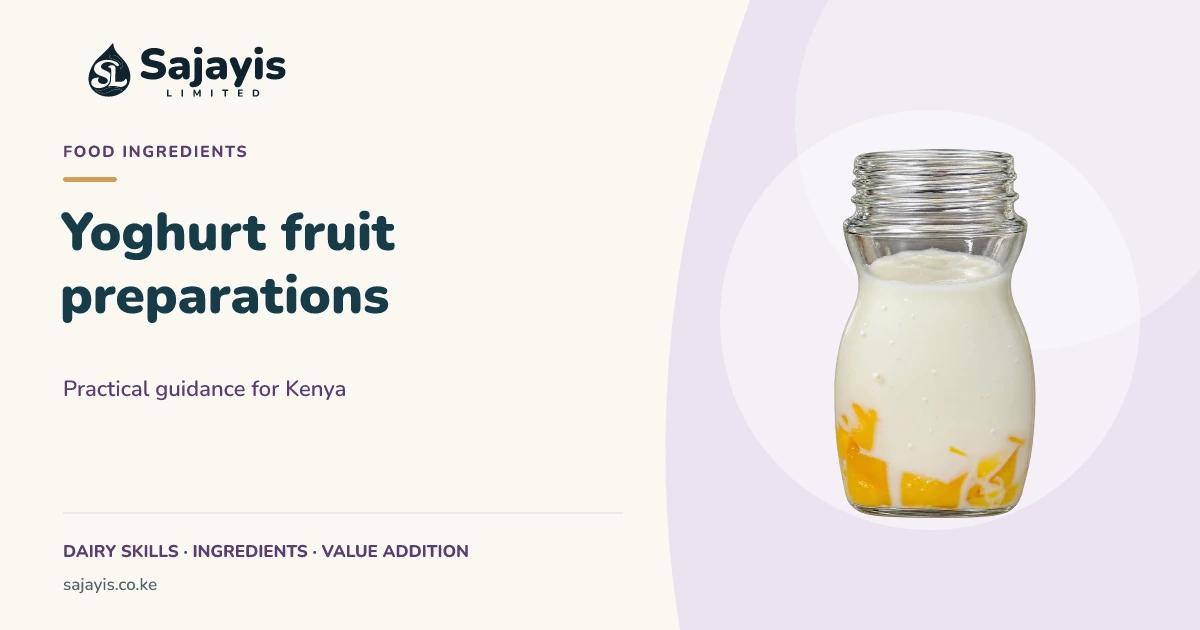
Keep a physical or photographic reference for the approved trial, with its record identity and assessment conditions. When you repeat the product, compare it using the same defined observations. A reference image is useful for appearance, but preserve the formulation and handling information too. The picture alone cannot explain why the product looked that way or establish its suitability.
Frequently asked questions
Are all mango ingredients interchangeable?
No. Fresh fruit, puree, syrup and prepared ingredients can differ in composition and application. Request the exact product information and assess it for your process. A shared flavour name does not establish identical performance or handling requirements.
Does a sealed commercial pack need no handling controls?
Do not assume that. Follow the actual storage, opening and application instructions and consider the point of addition. Your process still needs suitable hygiene and verification. Ask a competent adviser when the intended use differs from the documented application.
Can I choose fruit quantity by appearance alone?
Appearance is only one quality observation. Use a defined formulation and appropriate instructions, then assess flavour, distribution, pack suitability and relevant product requirements. Do not treat this article’s cost example as a recipe or recommended use level.
Does fruit yoghurt automatically have less added sugar?
No. The result depends on the actual base, preparation and other ingredients. Request verified ingredient and nutrition information where needed. A fruit image or natural description does not establish the amount of sugar in the finished food.
What should my first enquiry include?
State the intended yoghurt, desired fruit character, batch size and location. Ask for suitable products, specifications, handling instructions and current prices. Then plan a manageable trial before committing the ingredient to routine production or a large order.
Prepared with AI assistance using the linked sources and Sajayis catalogue checked on 12 November 2026. This article provides general information; illustrative calculations are identified in the text.