

A culture pack can look normal while its storage history remains unclear. Dairy culture storage decisions should follow the instructions for the exact product, from receiving and transport to opening and use. Guessing that every dried culture tolerates the same conditions can create avoidable uncertainty in production.
For Kenyan learners and small processors, a simple handling system can preserve useful information and make supplier conversations easier. This guide covers instructions, receiving, stock organisation, opening records and deviations. It also explains how to use the listed Sajayis culture price without inventing a universal storage temperature or packet coverage.
Dairy culture storage: begin with the exact pack
Identify the product before deciding where it belongs. Record its name, manufacturer or responsible supplier, lot and date information. Ask for the storage and handling instructions that apply to the actual pack rather than relying on a generic culture description.
The FAO starter culture manual explains the role of cultures in controlled milk fermentation. For purchasing and storage, the practical question is how the specific product should be maintained and used. Different culture products can have different instructions.
Keep those instructions available to the person receiving and using the material. If the information appears only in a supplier message on one owner’s phone, another worker may have no reliable guidance when the pack arrives.
Avoid copying a temperature or opened-pack period from another product. Even similar names do not establish identical formulation, packaging or handling requirements. A clear supplier answer is more useful than a confident assumption based on a previous purchase.
Plan the journey before the order is dispatched
Explain your location, collection time and expected journey to the supplier. Ask what transport arrangement is needed for the exact culture. If particular conditions apply, decide how they will be maintained until the pack reaches suitable storage.
Include waiting time. A short route can still involve a long delay at a collection point, workplace reception or an additional stop. A plan based only on distance can underestimate the actual period before storage.
Confirm who will receive the delivery and what they should check. The receiver needs enough information to identify a concern and know whom to contact. A pack should not be accepted without question merely because someone recognises the supplier’s name.
For buyers travelling from Nairobi to Kiambu, Thika or another county, discuss the actual journey rather than assuming the same arrangement suits every destination. If suitable handling cannot be confirmed, resolve that before dispatch instead of trying to reconstruct the history afterwards.
Dairy culture storage: use a receiving checklist
At arrival, compare the pack with the order and relevant documents. Check identity, quantity, integrity, date information and any receiving conditions specified for the product. Record the observations promptly and preserve the delivery reference.
| Receiving check | Information to retain |
|---|---|
| Product identity | Exact name and supplier |
| Traceability | Lot and purchase reference |
| Pack condition | Intact, damaged or otherwise uncertain |
| Date information | As printed on the actual pack |
| Handling history | Relevant confirmed transport information |
| Decision | Accepted, held or referred for advice |
Define what happens when information is missing. Mark uncertain material clearly and keep it separate from accepted stock. Then ask the supplier or competent adviser for a decision based on the facts available. Do not quietly invent a new acceptable history.
Make sure the physical stock and record agree. A culture listed as held in a spreadsheet should not remain unmarked beside packs ready for production. The next worker needs to understand the status without depending on a verbal warning they may never hear.
Organise storage so instructions remain visible
Choose storage that meets the actual product instructions and can support the quantity ordered. Keep packs identified and protected from damage. Follow the relevant equipment instructions and use appropriate checks where maintaining specific conditions is part of the system.
Arrange stock so workers can locate the correct product and date information. A suitable rotation system can reduce the chance of leaving older packs forgotten, but rotation does not make an unsuitable pack acceptable. Check the actual condition and instructions before use.
Do not store ingredients with unidentified materials or cleaning chemicals. If you use secondary containers or organisers, preserve the culture’s identity and relevant information. Convenience should not remove the details needed for traceability or handling.
Review storage after changes. A larger order, a new refrigerator or a different receiving arrangement can affect the system. Confirm the relevant conditions rather than assuming the original plan still works because the culture name has not changed.
Dairy culture storage: control opening and use
Ask whether the actual product supports partial use and what instructions apply after opening. Confirm the measuring, closing and storage method before production. A packet’s price and net weight do not establish that it can be divided safely or stored indefinitely.
Prepare the handling area and required tools according to the method. Keep the correct instructions and batch record available. Avoid unnecessary exposure of an opened pack while workers search for a scale, container or missing information.
Record opening and relevant use details. Link the culture lot to the production batch, quantity used and responsible person. Your dairy batch record system should preserve that connection so a later product concern can be investigated.
If the supplier advises using an entire pack for a defined application, do not replace that instruction with a guessed spoon fraction. Where your planned scale does not match the pack or method, ask for a suitable alternative or competent technical advice before starting.
Cost packs according to suitable use
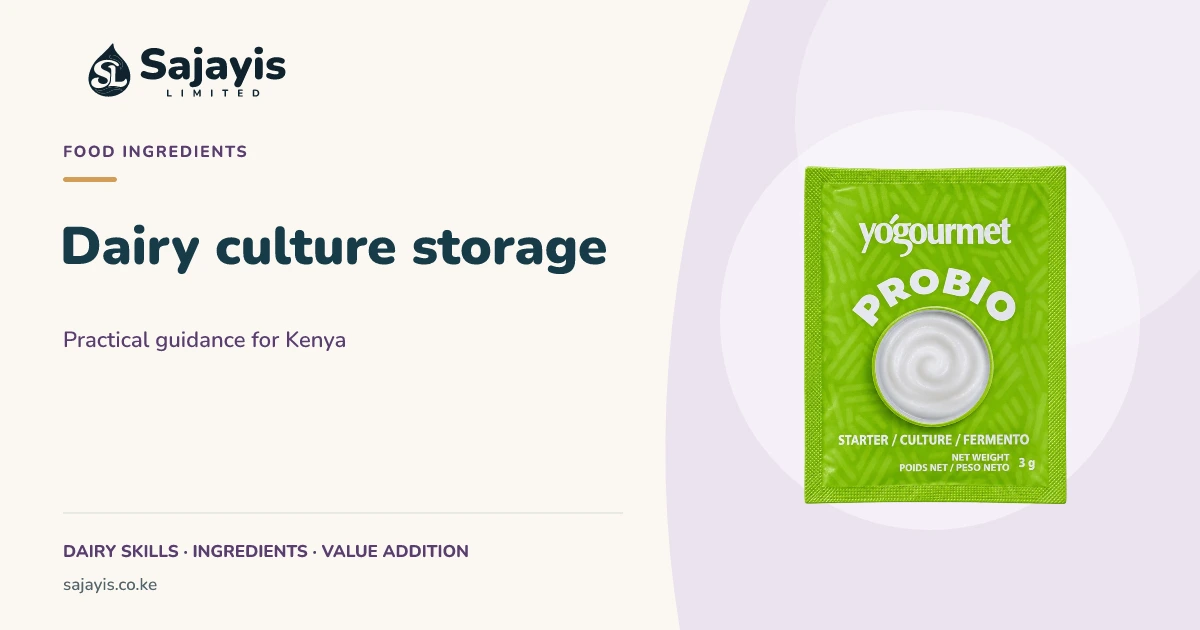
Sajayis lists Probio Culture at KSh 450, checked on 12 November 2026. Confirm the current pack, instructions, date and availability. The listing price does not by itself establish storage conditions, dose coverage or suitability for every dairy product.
Compare usable value rather than only packet price. A larger pack can be poor value when your production cannot use it within its instructions. Likewise, a delivery arrangement that fails the required conditions can undermine an apparently cheap purchase.
For an invented arithmetic example, suppose a documented pack costing KSh 600 supports six planned batches under the relevant instructions. The allocated culture cost would be KSh 100 per batch. This does not describe the coverage of Sajayis Probio Culture or recommend a dose.
Include appropriate transport and handling costs in your comparison. Keep quotations connected to exact products so the lowest price does not win by describing a different concentration, application or pack. Clear information improves both the technical and purchasing decision.
Dairy culture storage: prepare for deviations and learning
Write a short response for damaged packs, unclear dates or storage interruptions. Record what happened, which material may be affected and who reviews the concern. Follow product-specific advice rather than assuming that returning a pack to its usual storage reverses every earlier event.
Sajayis lists 55 Business Centre, next to Star Mall as its contact point. Call or WhatsApp +254 722 984117 for directions, stock and handling questions. Confirm the actual collection or dispatch arrangement before travelling or paying for transport.
If you need practical learning, review the dairy training options. Personalised Training and Three Products Training are each listed at KSh 6,500. Ask whether the current session addresses culture handling and your intended product; do not assume every specialist topic is included.
Send the exact pack name, intended batch size and question through the culture handling enquiry. A photograph of the label and a factual storage history can help the supplier understand the issue. Better information makes a decision more useful than a general statement that the culture seems weak.
Practise the receiving routine with a labelled training scenario before depending on it during production. Give the receiver a pack identity, delivery reference and a stated information gap. Ask them to record the concern, identify the hold location and explain whom they would contact. The exercise can reveal whether the instructions are usable by someone other than the person who designed the system.
Frequently asked questions
Can every dried culture use the same storage conditions?
No. Follow the instructions for the exact product. Different cultures and packs can have different requirements. Obtain the relevant information before buying or dispatching the material rather than transferring a rule from another supplier’s product.
Does an unopened pack remain suitable after any journey?
Do not assume that. Pack integrity and handling history are separate questions. Confirm the transport requirements and record relevant concerns on receipt. Ask the supplier for product-specific advice when required conditions or information are uncertain.
Can I divide a packet to save money?
First confirm whether partial use and your intended handling method are supported by the actual instructions. Net weight alone does not answer that question. Ask for a suitable pack or technical advice when your planned batch does not match the documented application.
What should I record after opening?
Keep the product identity, lot, relevant opening information, quantity used and link to the production batch. Follow any additional supplier instructions. The record should help another worker understand which material remains and how to handle it appropriately.
What is the best first enquiry?
Send the exact culture, intended product, batch size and location. Ask for storage, transport and application instructions plus a current price. Clear questions help you purchase a suitable quantity and organise receiving before the ingredient arrives.
Prepared with AI assistance using the linked sources and Sajayis catalogue checked on 12 November 2026. This article provides general information; illustrative calculations are identified in the text.