

A product can leave production in good condition and still arrive with an uncertain storage history. The dairy cold chain connects receiving, refrigeration, transport and customer handover. Each transfer needs a clear arrangement, especially when traffic, waiting or limited fridge space can extend the time before suitable storage.
For Kenyan households, caterers and small processors, the useful approach is to follow the actual product instructions and make responsibilities visible. This guide explains route planning, records, receiving and costs. It does not assign one universal temperature or travel allowance to every yoghurt, culture and frozen dairy product.
Dairy cold chain: start with product requirements
Identify what you are handling and read its instructions. Finished yoghurt, culture ingredients and frozen products may have different requirements. Do not assume that one insulated container or refrigerator arrangement suits every material simply because they all belong to the dairy business.
Record the product, intended quantity, storage conditions and relevant date information. Ask the supplier to clarify anything missing before planning dispatch. A pack’s size and price do not establish how it should travel or how long it can remain outside the required conditions.
The WHO safer food principles include maintaining suitable temperatures. In practice, that principle needs a plan for the actual product and journey. A general food-safety poster cannot decide whether an uncertain delivery is acceptable.
For a business, document who sets the handling requirements and who reviews a deviation. Workers should know which instructions apply and when to stop and ask. Clear responsibilities prevent an improvised decision from becoming the default response during a busy delivery period.
Map every handover and waiting point
Draw the journey from the supplier or production area to final storage. Include loading, dispatch, traffic, security checks, reception and unloading. A route can appear short while several unplanned waiting points create a much longer handling period.
Confirm who receives the order and where it goes next. An office reception desk may be convenient for a parcel but unsuitable as an indefinite holding point for chilled food. The receiving person needs to know the product’s requirements and the agreed handover time.
For an event, check usable refrigeration space before placing the order. A venue may have a fridge that is already allocated to other items. Ask about access times and the person responsible for moving the delivery into suitable storage.
Write these arrangements into the order or dispatch brief. A telephone conversation can resolve a question, but a clear recorded plan helps the driver, receiver and organiser work from the same information. Update the plan when a route or venue arrangement changes.
Dairy cold chain: choose transport for the real journey
Assess the product, quantity, journey and conditions together. Ask a competent supplier or adviser what equipment and handling arrangement are appropriate. Do not assume that a generic cooler will maintain the required conditions throughout every route.
Plan loading so products remain identified and protected. Include suitable packaging, stacking and separation from unrelated materials. Mechanical damage and temperature control are different issues; a secure lid does not prove that the product experienced the right storage conditions.
Consider route density and multiple stops. Combining orders can reduce transport cost, but it can also extend the journey for the last customer. Review that tradeoff using the actual requirements rather than treating the cheapest route as automatically suitable.
For longer journeys from Nairobi to Kiambu, Thika or another county, confirm the whole arrangement before accepting the order. This guide does not promise nationwide chilled delivery. A product should not be dispatched on the assumption that someone will solve the storage problem after arrival.
Use records that support a decision
Record the relevant product identity, dispatch, handover and observations required by your system. If temperature measurements form part of the plan, use suitable equipment and methods. A control dial or the feeling that a container is cool does not provide the same evidence as an appropriate measurement.
| Record point | Practical information |
|---|---|
| Before dispatch | Product, batch, quantity and status |
| Loading | Handling arrangement and responsible person |
| Journey | Relevant times, stops or deviations |
| Handover | Receiver, time and required checks |
| Storage | Confirmation of the next suitable location |
Connect the records to your batch traceability system. If a concern arises, you should be able to identify which product followed the affected route. A general note that deliveries went out today may not support that investigation.
Keep the record manageable and factual. Staff need to complete it during the work, not reconstruct an ideal journey later. Record missing information and the action taken rather than entering a reassuring number that nobody actually observed.
Dairy cold chain: budget the handling system
Include suitable transport, equipment, monitoring, staff time and relevant maintenance in your route cost. Also consider failed handovers and additional waiting. A product’s selling price should not be evaluated as if delivery requires no resources.
Use an invented example. If a suitable delivery route costs KSh 900 and carries 30 comparable saleable packs, the allocated route cost is KSh 30 per pack. If the same route serves only 15 packs, it becomes KSh 60 each. These are illustrations, not Sajayis delivery quotations.
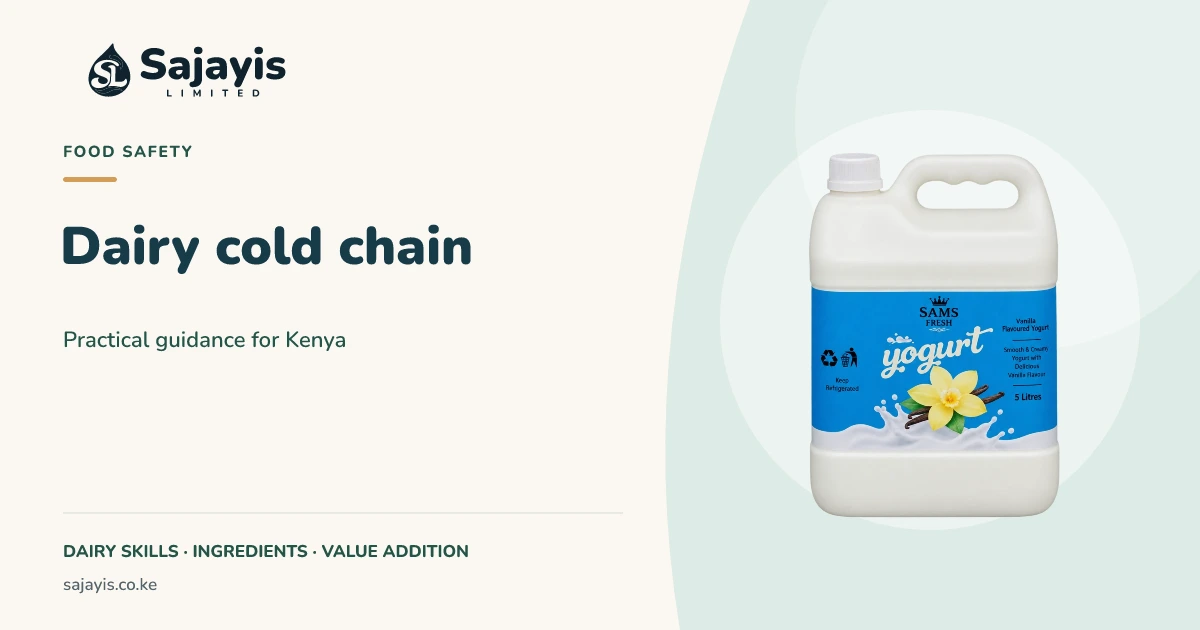
Sajayis lists 5 Litre Yoghurt at KSh 1,200, checked on 12 November 2026. That product price does not establish delivery cost or a handling plan for your destination. Confirm the actual product and full order arrangement.
Compare the cost of serving a location with realistic order quantities. A large geographic list is not the same as a practical distribution service. Define the areas and order conditions you can support consistently, then communicate them clearly to customers.
Prepare for interruptions and uncertain history
Write a response for delayed arrival, equipment trouble or an unavailable receiver. Identify who the driver or worker contacts and where affected product can be held appropriately while the issue is assessed. Planning the response beforehand reduces pressure to improvise.
If required conditions become uncertain, preserve the available facts and seek product-specific advice. Do not assume that making a pack cold again resets its history. Likewise, a printed date does not erase an unsuitable handling period.
Keep affected stock clearly identified and separate from product available for sale where the system requires a hold. Record who makes the final decision and why. Avoid serving uncertain food simply because the journey was expensive or the customer is waiting.
Review the cause afterwards. The improvement may involve route timing, receiver communication, equipment capacity or order limits. A useful investigation changes the relevant system rather than merely replacing one pack and repeating the same weak arrangement.
Dairy cold chain: confirm locations and support
Check the Sajayis delivery areas and fees for the intended address. Confirm the charge, timing, access and receiving arrangement. Coverage for one location should not be assumed to apply to every nearby address under identical conditions.
Sajayis lists 55 Business Centre, next to Star Mall as its contact point. Call or WhatsApp +254 722 984117 for directions and product questions. If collecting, explain the journey and ask about suitable handling before arriving.
For production learning, Three Products Training is listed at KSh 6,500. Ask which current safety, storage and packaging topics the workshop covers. A training session does not automatically validate every future delivery route or storage arrangement.
Use the delivery and product enquiry with the actual quantity, destination and required date. Clear details make it easier to agree a service the product and receiving location can support, rather than a promise based only on the distance shown on a map.
Rehearse a failed-handover scenario on paper. For example, the receiver is unavailable and the driver cannot access the agreed storage. State whom the driver calls, which suitable alternative is already agreed and how the decision is recorded. If the only answer is to leave the food somewhere convenient, the route plan still has an unresolved gap. Fix that gap before accepting the order rather than making the driver invent a food-handling decision at the gate.
Frequently asked questions
Do all dairy products need the same handling conditions?
No. Follow the actual product instructions. Cultures, chilled foods and frozen products can have different requirements. Confirm the material and journey before choosing transport or storage, and seek appropriate advice when the information is unclear.
Is a short distance always a safe delivery plan?
Distance alone does not describe the handling period. Traffic, waiting, access and delayed refrigeration can matter. Map the full handover and storage arrangement rather than assuming a nearby destination automatically creates suitable conditions.
Can a sealed pack replace temperature control?
No. Packaging integrity and suitable handling are separate requirements. A well-closed container does not establish that the product experienced the required conditions. Check both as appropriate for the actual food and distribution system.
What should happen after an uncertain journey?
Keep the product identified, preserve the available records and obtain product-specific advice. Follow the defined hold and decision process. Do not invent a new acceptable history merely because the pack now feels cold or the delivery cost was high.
What should I confirm before ordering from Sajayis?
Confirm the exact product, quantity, current price and handling instructions. Then agree service for the actual address, including timing and a receiver. Use the published delivery page as a starting point and clarify details directly before payment.
Prepared with AI assistance using the linked sources and Sajayis catalogue checked on 12 November 2026. This article provides general information; illustrative calculations are identified in the text.